
Power Distribution
Electrical power generation is the first step in the process of servicing user needs. The next step is power transmission and distribution, which is made up of multiple layers of major factors, all downstream of the generation source. The main components are primary power distribution stations, power substations, transformers (step-up and step-down versions), and high voltage transmission distribution towers and lines. Many industry experts estimate to achieve the 200 + GW power generation expansion proposed by 2050 will require the installation of 720,000 miles of new high voltage distribution infrastructure. This will not happen overnight, and it will cost $1.2-2.5 million per mile. Unfortunately, power distribution is rarely discussed or emphasized, despite the significant funding required to get the power from the source to the end user.
Distribution lines represent an inherent risk in their operation. During high wind conditions the line ark and become a primary source of wildfire.
Transformers
There are approximately 14 major and minor corporations manufacturing electrical transformers in the US. with some affiliates located in Mexico. Only 4 produce large scale transformers suitable to carry high voltage transmission level power.
In an article posted 9/23/2024 by Power Grid International, the National Infrastructure Advisory Council (NIAC) reported on transformer industries shortages and the recommended corrections. Simply stated, the industry may need to increase production by 160% -260% by 2050 †. NIAC lists 7 recommendations to increase production, the 3 most important are:
- Federal policies must target funding to increase domestic capacity.
- Pipeline of qualified workers must grow by partnering with universities, community colleges, and trade schools with training programs.
- Increased domestic production of Grain-Oriented Electrical Steel (GOES) or ES (Electric Steel), which is used to make transformers, and is in short supply worldwide, following the impact on the supply chain from Covid-19.
To further complicate the matter, the DOE in January 2024 initiated efficiency standards favoring the use of amorphous steel instead of ES core components material. This result would require the industry to redesign all current transformers. Fortunately, the change has been placed on hold by DOE as of April 2024.
As the NIAC report points out, the industry is currently experiencing 2-4 and in one case 5-year delivery delays of transformers. Unless there are significant changes at multiple levels within industry and government involvement, the entire expansion of the power generation industry may come to a halt before it starts.
Transmission Distribution System
The transfer of high voltage power (HVP) relies on hundreds of thousands of miles of HVP transmission lines and towers. Downstream of these systems is an even larger usage of medium transmission system.
The design, environmental impact studies, permit application, approval process, and obtaining rights-of-way usage permits on public, private, federal and Indian tribal lands, and the lawsuits which frequently occur are but a few of the hurdles utility companies and private parties must deal with to extend HVP to any location. In some cases, this process can take over 10 years to gain the right of ways needed. Following this process, actual construction and placement of HVP towers and lines can begin, with the time to complete construction depending on the length of the service line and terrain.
Another factor further hampering the construction of transmission lines is the shortage of qualified labor. Training for Certified HVP linemen can take up to 7 years. Working conditions can be severe in terms of climate, location, and terrain. Workers are typically gone from their homes for long periods of time. The industry, as mentioned in the transformers section above, is promoting entry level employment for these highly skilled jobs, but there remains a current lack of certified linemen to meet the needs. Both private and public entities must encourage the expansion of these highly skilled roles.
Lastly, the HVP line material is in high demand for 130kV -220kV, 221-600kV transition line material for overhead, underground and submersible applications. The industry experienced considerable disruption during COVID-19 and is currently in recovery ˩ ˩. The industry will need to gear up to meet the growing demand of copper, aluminum cable, galvanized steel cable and other materials.
Substations
The design and construction of substations used to convert HVP to a usable voltage level is not overly complex; success is on the availability of the proper type of transformer. Thousands of new facilities will be needed to handle the promised 200+ GWs of power. Local municipalities must become involved, along with regional ISO (Independent System Operator) and state power utility companies, to facilitate the construction of medium voltage transmission lines to distribute this new power to users.
Additional Challenges
Whether it is the advanced technology needed to produce Fission or Fusion power, material changes or techniques to support the applications, industry must and is changing.
Welding exotic materials used in the reaction chamber vessels and piping system with exposure to various types of corrosive chemical, such as molten salt circulating substances as well as the superheated piping exposed to heat exchanges chemicals, represents a major challenge in reducing the corrosive process of piping and weldment joints. Materials used in the construction of these systems and the use of Hastelloy N 242 material is one possibility. SMR system’s operational life expectancy is 10 to 20 + years. Exposure to highly corrosive chemicals creates challenges for industry. New welding processes are already in review by ASME board members to address these conditions.
The other concern is finding qualified welders to perform these high-quality weldment applications. The available labor pool for these skill sets is extremely limited. Welders take years to develop the techniques and certification rating need to perform this work. Welding exotic materials is as much an art form as it is skill set. The industry must take the necessary steps to promote and train these vital workers. One welding training program in Indiana has just announced, with the help of a $500,000 donation from BWX, US Navy and others, to open High School welding training facility ɬ. These types of efforts are needed for all critical industry sectors!
Summary
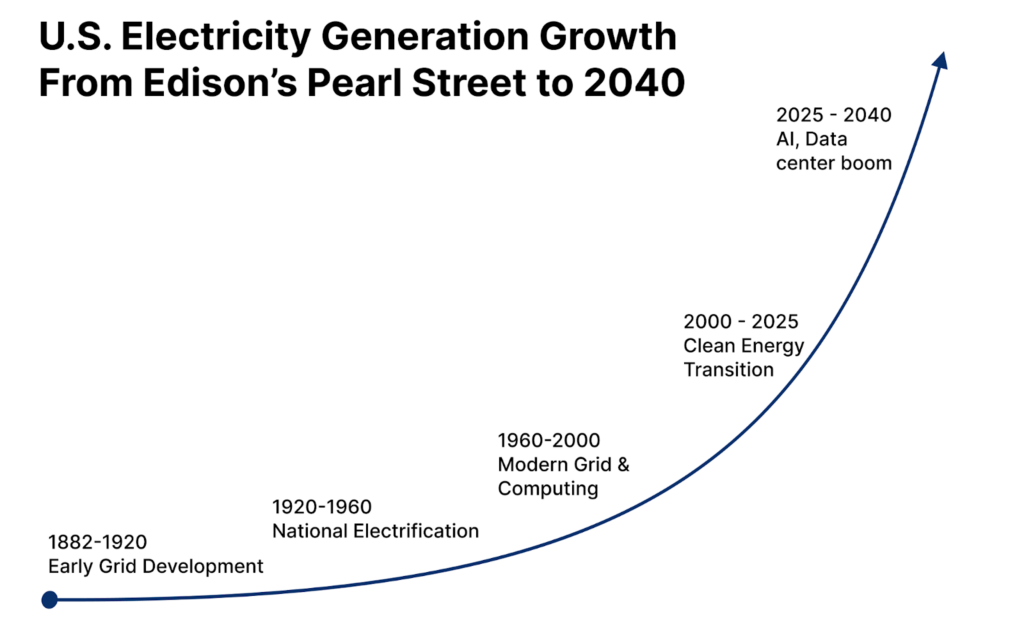
The USA has been building its power and distribution system since Thomas Edison’s Pearl Street Station opened over 140 years ago. There are hundreds of power grid operating agencies at regional, state, and municipal levels servicing millions of users in homes, businesses, and industrial facilities of all sizes. The next phase of power buildout represents a quantum leap for an industry to be accomplished in a quarter of the time frame it took to build the system since Edison’s time.
CICS, LLC provides this energy overview to assist business leaders in understanding the current and future status of power generation. Industries are in a race to find available, reliable power for all types of user needs. With the construction of large-scale data centers in the 1990s, the advent of electric vehicles such as Toyota Prius in 1997 and 2008 with Tesla Model S, and now with data engines such as GPU/CPU processing consuming 300+watts per processer, both the cost and availability of power threatens to derail the plans of many end users.
Only a glimpse of each power sector and relevant challenges is provided above, but as these issues become clearer, the available near-term choices come into focus. If large scale power is what your business needs and the need is within the next 5 years, SMR technology at your property is a clear option.
CICS, LLC has the capability to assist your business with the process of determining your power evaluation. Let us help you get there.
Information for this article is relevant as of 120/2025. Energy statistics listed in this article are from DOE Reports for 2023 as well as other sources, see foot notes below.
Author:
Mark Cuzner, CEO
CICS, LLC
Foot Notes:
- * https://www.dailyrepublic.com/news/fairfield/fairfield-brewery-gets-mammoth-wind-turbine-to-power-plant/article_168d3c47-2ce4-5cce-9597-f942f3b6d2bf.html
- ** https://www.ans.org/news/article-6555/us-unveils-road-map-to-triple-nuclear-capacity-by-2050/
- † https://www.power-grid.com/td/the-u-s-has-a-critical-shortage-of-power-transformers-can-it-bounce-back/
- †† https://www.energysage.com/about-clean-energy/wind/pros-cons-wind-energy/
- ‡ https://www.solarreviews.com/blog/wind-energy-pros-and-cons
- ɬ https://www.ans.org/news/article-6573/new-welding-school-opens-for-high-schoolers/
- ɬɬ https://www.energy.gov/ne/articles/triso-particles-most-robust-nuclear-fuel-earth
- ˩ https://investingnews.com/top-uranium-reserves-by-country/
- ˩ ˩ https://www.fortunebusinessinsights.com/transmission-line-market-106347
- ˩ ˩ ˩ https://justthenews.com/politics-policy/energy/grid-watchdog-warns-future-blackouts-and-need-natural-gas-power-support
- × https://www.breitbart.com/politics/2024/11/25/exclusive-crescent-dunes-biden-doj-moved-election-night-cover-up-alleged-solar-energy-scandal/
- ×× https://www.whitehouse.gov/wp-content/uploads/2024/11/US-Nuclear-Energy-Deployment-Framework.pdf
- ××× https://www.carbonbrief.org/china-responsible-for-95-of-new-coal-power-construction-in-2023-report-says
- ¥ https://justthenews.com/politics-policy/energy/rural-communities-fought-wind-and-solar-developments-2024-some-states-may
- 0 https://robertbryce.substack.com/p/heres-the-real-hockey-stick
- 00 https://www.eia.gov/tools/faqs/faq.php?id=427&t=3
- ±± https://www.nei.org/news/2015/land-needs-for-wind-solar-dwarf-nuclear-plants